25 free questions · No card25 questions free · Complete Exam Pass $14.99 · No subscription
Loading…
Practice workspace
DP-700AssociateMicrosoftFree 25-question previewPage 1 of 1
Implementing Data Engineering Solutions Using Microsoft Fabric practice questions
Try 25 supported questions from the 113-question bank. Check each answer when you are ready and keep this preview’s progress privately in your browser.
This sample includes answers, available explanations, official references and curated community discussion. An Exam Pass unlocks the private complete bank for this exam.
You have a Fabric warehouse named DW1. DW1 contains a table that stores sales data and is used by multiple sales representatives. You plan to implement row-level security (RLS). You need to ensure that the sales representatives can see only their respective data. Which warehouse object do you require to implement RLS?
Show answer
Correct answer: D
How others answered
D100%
Explanation
To implement Row-Level Security (RLS) in a Fabric warehouse like DW1, need to use a FUNCTION to define the filtering logic. Specifically, a user-defined function (UDF) is created and associated with the RLS policy to determine which rows each user can access.
Adapted from community discussion by QAZdbarhate12345678 · 2024-12-15 · 5 community upvotes. Third-party contribution; reviewed by our quality filter, not independently verified.
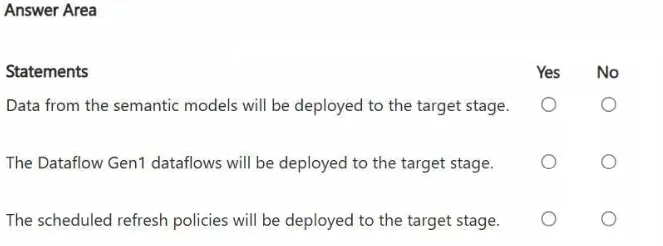
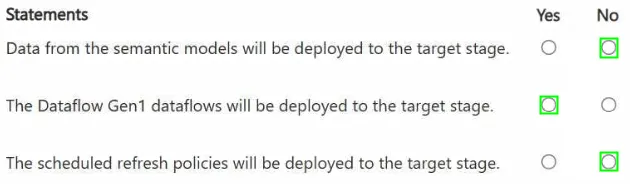
HOTSPOT - You have a Fabric workspace named Workspace1_DEV that contains the following items: 10 reports Four notebooks - Three lakehouses - Two data pipelines - Two Dataflow Gen1 dataflows - Three Dataflow Gen2 dataflows - Five semantic models that each has a scheduled refresh policy You create a deployment pipeline named Pipeline1 to move items from Workspace1_DEV to a new workspace named Workspace1_TEST. You deploy all the items from Workspace1_DEV to Workspace1_TEST. For each of the following statements, select Yes if the statement is true. Otherwise, select No. NOTE: Each correct selection is worth one point.
This is an interactive task on the real exam — a drag-and-drop, hotspot or ordering question. There is nothing to select here, so the answer is shown below for reference.
Show the answer figure
Answer
Explanation
NO: only metadata will be deployed to the target starge (https://learn.microsoft.com/en-us/fabric/cicd/deployment-pipelines/understand-the-deployment-process?tabs=new#item-properties-copied-during-deployment) YES: Gen1 dataflows will be deployed NO: Refresh schedules will not be deployed (https://learn.microsoft.com/en-us/fabric/cicd/deployment-pipelines/understand-the-deployment-process?tabs=new#item-properties-copied-during-deployment)
Adapted from community discussion by SamuComqi · 2025-01-02 · 19 community upvotes. Third-party contribution; reviewed by our quality filter, not independently verified.
You have a Fabric deployment pipeline that uses three workspaces named Dev, Test, and Prod. You need to deploy an eventhouse as part of the deployment process. What should you use to add the eventhouse to the deployment process?
Show answer
Correct answer: B
How others answered
B88%
Explanation
In Microsoft Fabric, deployment pipelines are the recommended and built-in method for managing and deploying artifacts (like eventhouses, lakehouses, datasets, and reports) across environments such as Dev, Test, and Prod.
Adapted from community discussion by QAZdbarhate12345678 · 2024-12-15 · 5 community upvotes. Third-party contribution; reviewed by our quality filter, not independently verified.
You have a Fabric workspace that contains a Real-Time Intelligence solution and an eventhouse. Users report that from OneLake file explorer, they cannot see the data from the eventhouse. You enable OneLake availability for the eventhouse. What will be copied to OneLake?
Show answer
Correct answer: E
How others answered
E75%
D25%
Explanation
When you enable OneLake availability for an eventhouse in Microsoft Fabric, only new data ingested into the eventhouse will be synced and made available in OneLake.
Adapted from community discussion by IshtarSQL · 2024-12-10 · 7 community upvotes. Third-party contribution; reviewed by our quality filter, not independently verified.
You have a Fabric workspace named Workspace1. You plan to integrate Workspace1 with Azure DevOps. You will use a Fabric deployment pipeline named deployPipeline1 to deploy items from Workspace1 to higher environment workspaces as part of a medallion architecture. You will run deployPipeline1 by using an API call from an Azure DevOps pipeline. You need to configure API authentication between Azure DevOps and Fabric. Which type of authentication should you use?
Show answer
Correct answer: A
How others answered
A60%
B30%
Only 60% agreed on this answer — treat it as contested rather than settled.
Explanation
To configure API authentication between Azure DevOps and Fabric, a service principal is the recommended approach. Workspace identity: Workspace identities are a feature within Fabric itself. They are used to control access to resources within the Fabric workspace. While relevant for managing access within Fabric, they don't directly facilitate authentication with external services like Azure DevOps.
Adapted from community discussion by viskas · 2025-01-22 · 3 community upvotes. Third-party contribution; reviewed by our quality filter, not independently verified.
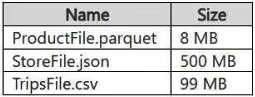
You have a Google Cloud Storage (GCS) container named storage1 that contains the files shown in the following table.
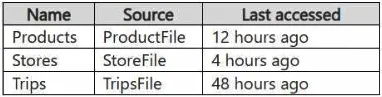
You have a Fabric workspace named Workspace1 that has the cache for shortcuts enabled. Workspace1 contains a lakehouse named Lakehouse1. Lakehouse1 has the shortcuts shown in the following table.
You need to read data from all the shortcuts. Which shortcuts will retrieve data from the cache?
Show answer
Correct answer: C
How others answered
C90%
Explanation
Shortcut caching can be used to reduce egress costs associated with cross-cloud data access. As files are read through an external shortcut, the files are stored in a cache for the Fabric workspace. Subsequent read requests are served from cache rather than the remote storage provider. Cached files have a retention period of 24 hours. https://learn.microsoft.com/en-us/fabric/onelake/onelake-shortcuts#caching
Adapted from community discussion by Tuki93 · 2024-12-08 · 14 community upvotes. Third-party contribution; reviewed by our quality filter, not independently verified.
You have an Azure Data Lake Storage Gen2 account named storage1 and an Amazon S3 bucket named storage2. You have the Delta Parquet files shown in the following table.
You have a Fabric workspace named Workspace1 that has the cache for shortcuts enabled. Workspace1 contains a lakehouse named Lakehouse1. Lakehouse1 has the following shortcuts: A shortcut to ProductFile aliased as Products A shortcut to StoreFile aliased as Stores A shortcut to TripsFile aliased as Trips The data from which shortcuts will be retrieved from the cache?
Show answer
Correct answer: C
How others answered
C46%
B41%
Only 46% agreed on this answer — treat it as contested rather than settled.
Explanation
Shortcut caching is currently only supported for GCS, S3 and S3 compatible shortcuts. If a file hasn’t been accessed for more than 24 hrs it's purged from the cache. Individual files greater than 1 GB in size aren't cached https://learn.microsoft.com/en-us/fabric/onelake/onelake-shortcuts#caching
Adapted from community discussion by Tuki93 · 2025-01-24 · 6 community upvotes. Third-party contribution; reviewed by our quality filter, not independently verified.
You have a Fabric workspace. You have semi-structured data. You need to read the data by using T-SQL, KQL, and Apache Spark. The data will only be written by using Spark. What should you use to store the data?
Show answer
Correct answer: B
How others answered
B57%
A43%
Only 57% agreed on this answer — treat it as contested rather than settled.
Explanation
The eventhouse is the only one out of the four options that allows the creation of a KQL Database, therefore it is the only option that fully meets the criteria (being able to read the date via KQL, T-SQL and Spark).
Adapted from community discussion by mmanrik · 2025-01-16 · 3 community upvotes. Third-party contribution; reviewed by our quality filter, not independently verified.
Your company has a sales department that uses two Fabric workspaces named Workspace1 and Workspace2. The company decides to implement a domain strategy to organize the workspaces. You need to ensure that a user can perform the following tasks: Create a new domain for the sales department. Create two subdomains: one for the east region and one for the west region. Assign Workspace1 to the east region subdomain. Assign Workspace2 to the west region subdomain. The solution must follow the principle of least privilege. Which role should you assign to the user?
Show answer
Correct answer: D
How others answered
D79%
B15%
Explanation
Domain admins can only manage domains they are assigned to. Fabric Admin: Fabric admins can create and edit domains, specify domain admins and contributors, and associate workspaces with domains. They have full visibility and control over all defined domains. Domain Admin: Domain admins can manage the domains they are assigned to, including creating subdomains and managing domain-specific settings
Adapted from community discussion by Stretchy · 2025-03-06 · 2 community upvotes. Third-party contribution; reviewed by our quality filter, not independently verified.
You have a Fabric workspace named Workspace1 that contains a warehouse named DW1 and a data pipeline named Pipeline1. You plan to add a user named User3 to Workspace1. You need to ensure that User3 can perform the following actions: View all the items in Workspace1. Update the tables in DW1. The solution must follow the principle of least privilege. You already assigned the appropriate object-level permissions to DW1. Which workspace role should you assign to User3?
Show answer
Correct answer: D
How others answered
D48%
B28%
C24%
Only 48% agreed on this answer — treat it as contested rather than settled.
Explanation
Viewer - Can view all content in the workspace, but can't modify it. Contributor - Can view and modify all content in the workspace. Member - Can view, modify, and share all content in the workspace. Can add Members Admin - Can view, modify, share, and manage all content in the workspace, including managing permissions. - Can add Admins, Members and can delete workspace. So Contributor is the least role who can view and update the tables (modify the content).
Adapted from community discussion by Bovote · 2025-01-29 · 8 community upvotes. Third-party contribution; reviewed by our quality filter, not independently verified.
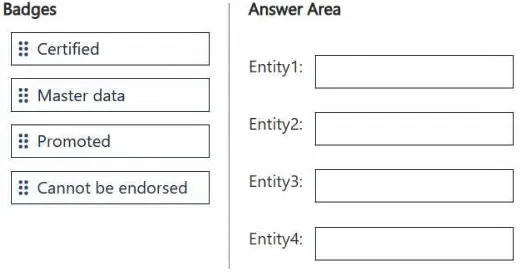
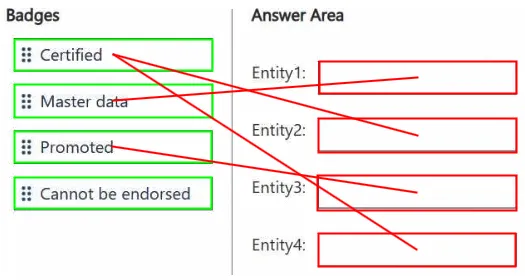
DRAG DROP - You are implementing the following data entities in a Fabric environment: Entity1: Available in a lakehouse and contains data that will be used as a core organization entity Entity2: Available in a semantic model and contains data that meets organizational standards Entity3: Available in a Microsoft Power BI report and contains data that is ready for sharing and reuse Entity4: Available in a Power BI dashboard and contains approved data for executive-level decision making Your company requires that specific governance processes be implemented for the data. You need to apply endorsement badges to the entities based on each entity’s use case. Which badge should you apply to each entity? To answer, drag the appropriate badges the correct entities. Each badge may be used once, more than once, or not at all. You may need to drag the split bar between panes or scroll to view content. NOTE: Each correct selection is worth one point.
This is an interactive task on the real exam — a drag-and-drop, hotspot or ordering question. There is nothing to select here, so the answer is shown below for reference.
Show the answer figure
Answer
Explanation
Entity1: core organization entity --> Master Data Entity2: meets organizational standards --> Certified Entity3: ready for sharing and reuse --> Promoted Entity4: Power BI dashboard, executive-level decision making --> Cannot be endorsed, The reason is Types of items that can be endorsed All Fabric items and Power BI items except Power BI dashboards can be promoted or certified.
Adapted from community discussion by fassil · 2025-02-27 · 9 community upvotes. Third-party contribution; reviewed by our quality filter, not independently verified.
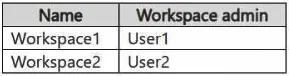
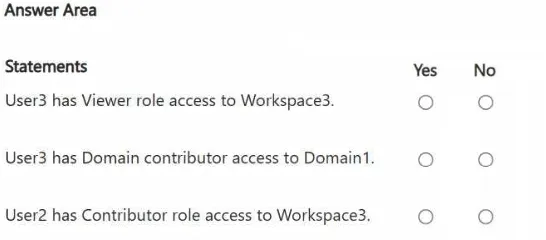
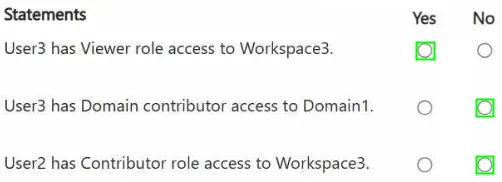
HOTSPOT - You have three users named User1, User2, and User3. You have the Fabric workspaces shown in the following table.
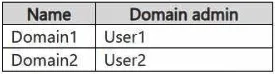
You have a security group named Group1 that contains User1 and User3. The Fabric admin creates the domains shown in the following table.
User1 creates a new workspace named Workspace3. You add Group1 to the default domain of Domain1. For each of the following statements, select Yes if the statement is true. Otherwise, select No. NOTE: Each correct selection is worth one point.
This is an interactive task on the real exam — a drag-and-drop, hotspot or ordering question. There is nothing to select here, so the answer is shown below for reference.
Show the answer figure
Answer
Explanation
NYN Being a domain contributor doesn't give you any permissions on the workspace itself, only on the domain. Workspace roles are set differently. This excludes the first and last option. User 3 will be domain contributor on the new workspace. Even though without domain admin permissions, there's nothing user 3 can do with Workspace 3.
Adapted from community discussion by giraf · 2025-02-15 · 9 community upvotes. Third-party contribution; reviewed by our quality filter, not independently verified.
You have a Fabric workspace that contains a lakehouse and a notebook named Notebook1. Notebook1 reads data into a DataFrame from a table named Table1 and applies transformation logic. The data from the DataFrame is then written to a new Delta table named Table2 by using a merge operation. You need to consolidate the underlying Parquet files in Table1. Which command should you run?
Show answer
Correct answer: C
How others answered
C100%
Explanation
In Delta Lake, the OPTIMIZE command is used to consolidate small Parquet files into larger ones. This improves query performance by reducing the overhead of managing many small files. VACUUM command is used to clean up and remove files that are no longer needed (e.g., old versions of data files, deleted files)
Adapted from community discussion by henryphchan · 2025-02-16 · 2 community upvotes. Third-party contribution; reviewed by our quality filter, not independently verified.
You have a Fabric workspace that contains a warehouse named Warehouse1. You have an on-premises Microsoft SQL Server database named Database1 that is accessed by using an on-premises data gateway. You need to copy data from Database1 to Warehouse1. Which item should you use?
Show answer
Correct answer: B
How others answered
B100%
Explanation
B. Notebooks can’t go through a gateway, KQL isn’t appropriate for a sql db. Gen1 dataflows are deprecated. Data pipelines work through a datagateway and are fast
Adapted from community discussion by robertlavigne · 2025-01-23 · 8 community upvotes. Third-party contribution; reviewed by our quality filter, not independently verified.
Note: This question is part of a series of questions that present the same scenario. Each question in the series contains a unique solution that might meet the stated goals. Some question sets might have more than one correct solution, while others might not have a correct solution. After you answer a question in this section, you will NOT be able to return to it. As a result, these questions will not appear in the review screen. You have a Fabric eventstream that loads data into a table named Bike_Location in a KQL database. The table contains the following columns: BikepointID - Street - Neighbourhood - No_Bikes - No_Empty_Docks - Timestamp - You need to apply transformation and filter logic to prepare the data for consumption. The solution must return data for a neighbourhood named Sands End when No_Bikes is at least 15. The results must be ordered by No_Bikes in ascending order. Solution: You use the following code segment:
Does this meet the goal?
Show answer
Correct answer: B
How others answered
B100%
Explanation
The answer is B. No because the "sort by" is sorting values in descending order (default behavior --> https://learn.microsoft.com/en-us/kusto/query/sort-operator?view=microsoft-fabric). One should add "asc" to sort values as required. The double "project" at the end does not affect the final result
Adapted from community discussion by SamuComqi · 2024-12-31 · 9 community upvotes. Third-party contribution; reviewed by our quality filter, not independently verified.
You have a Fabric F32 capacity that contains a workspace. The workspace contains a warehouse named DW1 that is modelled by using MD5 hash surrogate keys. DW1 contains a single fact table that has grown from 200 million rows to 500 million rows during the past year. You have Microsoft Power BI reports that are based on Direct Lake. The reports show year-over-year values. Users report that the performance of some of the reports has degraded over time and some visuals show errors. You need to resolve the performance issues. The solution must meet the following requirements: Provide the best query performance. Minimize operational costs. Which should you do?
Show answer
Correct answer: C
How others answered
C42%
D38%
B20%
Only 42% agreed on this answer — treat it as contested rather than settled.
Explanation
Enable V-Order: This should be your first step as it directly targets performance improvements with minimal cost. Consider the following before deciding to disable V-Order: Microsoft Fabric Direct Lake mode depends on V-Order. https://learn.microsoft.com/en-us/fabric/data-warehouse/v-order#performance-considerations
Adapted from community discussion by Tuki93 · 2024-12-08 · 13 community upvotes. Third-party contribution; reviewed by our quality filter, not independently verified.
You have a Fabric workspace named Workspace1 that contains a notebook named Notebook1. In Workspace1, you create a new notebook named Notebook2. You need to ensure that you can attach Notebook2 to the same Apache Spark session as Notebook1. What should you do?
Show answer
Correct answer: A
How others answered
A100%
Explanation
In Azure Fabric, when you want to share the same Apache Spark session across multiple notebooks, enabling high concurrency mode is essential. High concurrency mode allows multiple notebooks to share the same Spark session, facilitating collaboration and efficient resource usage.
Adapted from community discussion by QAZdbarhate12345678 · 2024-12-15 · 6 community upvotes. Third-party contribution; reviewed by our quality filter, not independently verified.
You have a Fabric workspace named Workspace1 that contains a lakehouse named Lakehouse1. Lakehouse1 contains the following tables: Orders - Customer - Employee - The Employee table contains Personally Identifiable Information (PII). A data engineer is building a workflow that requires writing data to the Customer table, however, the user does NOT have the elevated permissions required to view the contents of the Employee table. You need to ensure that the data engineer can write data to the Customer table without reading data from the Employee table. Which three actions should you perform? Each correct answer presents part of the solution. NOTE: Each correct selection is worth one point.
Show answer
Correct answer: D, E, F
How others answered
DEF82%
Explanation
First we need to do F and E to separate the Employee table from the other tables. Then they need contributor access to be able to write to the Customer table which is in Workspace1 A is incorrect as sharing only gives read access. https://learn.microsoft.com/en-us/fabric/data-engineering/lakehouse-sharing B is incorrect as Workspace2 has the Employee table which the data engineer shouldn’t access. C is incorrect as viewer won’t allow them to write and the Customer table isn’t even in that workspace E is incorrect as viewer won’t allow them to write
Adapted from community discussion by robertlavigne · 2025-01-23 · 3 community upvotes. Third-party contribution; reviewed by our quality filter, not independently verified.
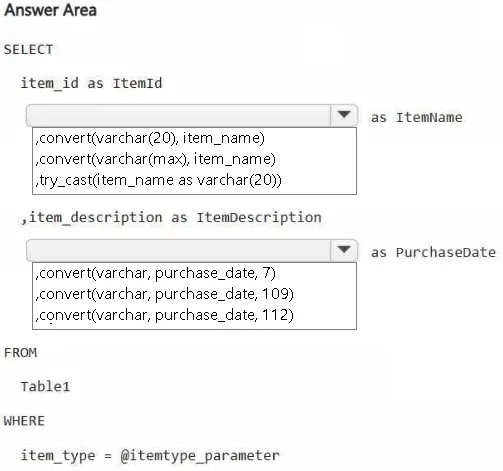
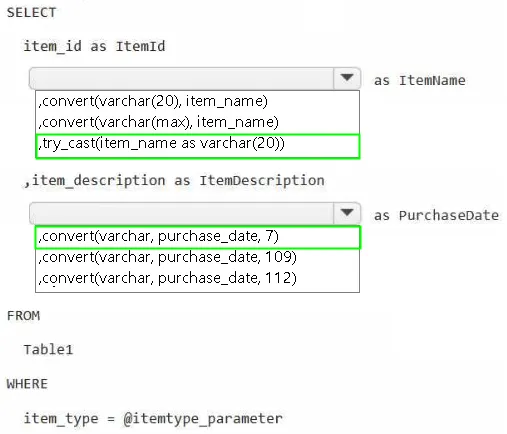
HOTSPOT - You have a Fabric workspace. You are debugging a statement and discover the following issues: Sometimes, the statement fails to return all the expected rows. The PurchaseDate output column is NOT in the expected format of mmm dd, yy. You need to resolve the issues. The solution must ensure that the data types of the results are retained. The results can contain blank cells. How should you complete the statement? To answer, select the appropriate options in the answer area. NOTE: Each correct selection is worth one point.
This is an interactive task on the real exam — a drag-and-drop, hotspot or ordering question. There is nothing to select here, so the answer is shown below for reference.
Show the answer figure
Answer
Explanation
As a european I would not know it has to be 7, we never use that format and I do not know (or want to know) all formats by heart..... try_cast: https://learn.microsoft.com/en-us/sql/t-sql/functions/try-cast-transact-sql?view=sql-server-ver16 convert: https://learn.microsoft.com/en-us/sql/t-sql/functions/cast- and-convert-transact-sql?view=sql-server-ver16
Adapted from community discussion by 8d6881f · 2025-01-30 · 2 community upvotes. Third-party contribution; reviewed by our quality filter, not independently verified.
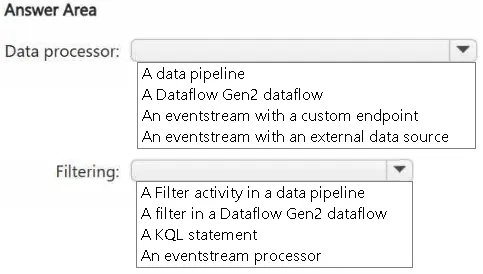
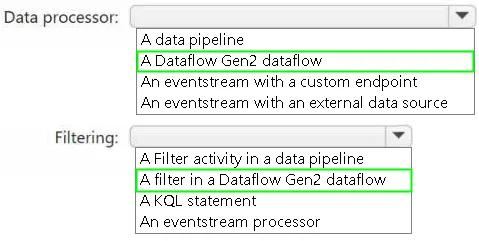
HOTSPOT - You have an Azure Event Hubs data source that contains weather data. You ingest the data from the data source by using an eventstream named Eventstream1. Eventstream1 uses a lakehouse as the destination. You need to batch ingest only rows from the data source where the City attribute has a value of Kansas. The filter must be added before the destination. The solution must minimize development effort. What should you use for the data processor and filtering? To answer, select the appropriate options in the answer area. NOTE: Each correct selection is worth one point.
This is an interactive task on the real exam — a drag-and-drop, hotspot or ordering question. There is nothing to select here, so the answer is shown below for reference.
Show the answer figure
Answer
Explanation
The answer is correct. The question states that eventstream already exists and uses the lakehouse as destination. The question also states that the rows need to be batch ingested. Thus 1) Dataflow and 2) Filter activity are the best in this situation
Adapted from community discussion by 18e18d0 · 2025-02-08 · 5 community upvotes. Third-party contribution; reviewed by our quality filter, not independently verified.
You have a Fabric workspace that contains an eventstream named Eventstream1. Eventstream1 processes data from a thermal sensor by using event stream processing, and then stores the data in a lakehouse. You need to modify Eventstream1 to include the standard deviation of the temperature. Which transform operator should you include in the Eventstream1 logic?
Show answer
Correct answer: B
How others answered
B93%
Explanation
The Group by transform operator contains the Standard deviation aggregation. The Aggregate transform operator only contains Average, Max, Min and Sum aggregation.
Adapted from community discussion by GHill1982 · 2024-12-31 · 7 community upvotes. Third-party contribution; reviewed by our quality filter, not independently verified.
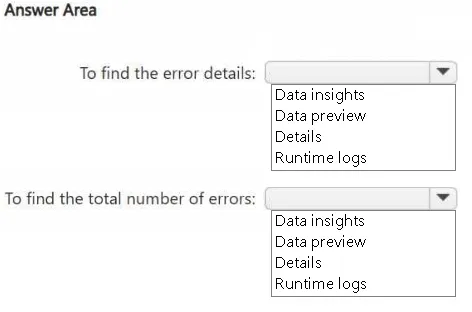
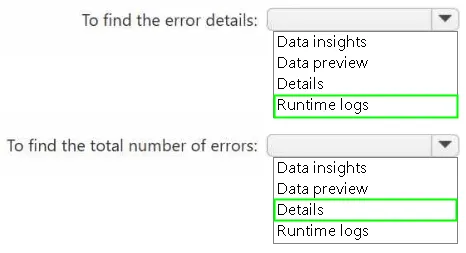
HOTSPOT - You have a Fabric workspace that contains an eventstream named EventStream1. You discover that an EventStream1 transformation fails. You need to find the following error information: The error details, including the occurrence time The total number of errors - What should you use? To answer, select the appropriate options in the answer area. NOTE: Each correct selection is worth one point.
This is an interactive task on the real exam — a drag-and-drop, hotspot or ordering question. There is nothing to select here, so the answer is shown below for reference.
Show the answer figure
Answer
Explanation
For this scenario involving a failed transformation in EventStream1, here are the correct selections: To find the error details, including the occurrence time: ✅ Runtime logs Runtime logs provide detailed error messages and timestamps when the error occurred. To find the total number of errors: ✅ Data insights Data insights summarize metrics such as the total number of errors, throughput, and performance statistics.
Adapted from community discussion by DarkDerf · 2025-03-22 · 3 community upvotes. Third-party contribution; reviewed by our quality filter, not independently verified.
Case Study - This is a case study. Case studies are not timed separately. You can use as much exam time as you would like to complete each case. However, there may be additional case studies and sections on this exam. You must manage your time to ensure that you are able to complete all questions included on this exam in the time provided. To answer the questions included in a case study, you will need to reference information that is provided in the case study. Case studies might contain exhibits and other resources that provide more information about the scenario that is described in the case study. Each question is independent of the other questions in this case study. At the end of this case study, a review screen will appear. This screen allows you to review your answers and to make changes before you move to the next section of the exam. After you begin a new section, you cannot return to this section. To start the case study - To display the first question in this case study, click the Next button. Use the buttons in the left pane to explore the content of the case study before you answer the questions. Clicking these buttons displays information such as business requirements, existing environment, and problem statements. If the case study has an All Information tab, note that the information displayed is identical to the information displayed on the subsequent tabs. When you are ready to answer a question, click the Question button to return to the question. Overview. Company Overview - Contoso, Ltd. is an online retail company that wants to modernize its analytics platform by moving to Fabric. The company plans to begin using Fabric for marketing analytics. Overview. IT Structure - The company’s IT department has a team of data analysts and a team of data engineers that use analytics systems. The data engineers perform the ingestion, transformation, and loading of data. They prefer to use Python or SQL to transform the data. The data analysts query data and create semantic models and reports. They are qualified to write queries in Power Query and T-SQL. Existing Environment. Fabric - Contoso has an F64 capacity named Cap1. All Fabric users are allowed to create items. Contoso has two workspaces named WorkspaceA and WorkspaceB that currently use Pro license mode. Existing Environment. Source Systems Contoso has a point of sale (POS) system named POS1 that uses an instance of SQL Server on Azure Virtual Machines in the same Microsoft Entra tenant as Fabric. The host virtual machine is on a private virtual network that has public access blocked. POS1 contains all the sales transactions that were processed on the company’s website. The company has a software as a service (SaaS) online marketing app named MAR1. MAR1 has seven entities. The entities contain data that relates to email open rates and interaction rates, as well as website interactions. The data can be exported from MAR1 by calling REST APIs. Each entity has a different endpoint. Contoso has been using MAR1 for one year. Data from prior years is stored in Parquet files in an Amazon Simple Storage Service (Amazon S3) bucket. There are 12 files that range in size from 300 MB to 900 MB and relate to email interactions. Existing Environment. Product Data POS1 contains a product list and related data. The data comes from the following three tables: Products - ProductCategories - ProductSubcategories - In the data, products are related to product subcategories, and subcategories are related to product categories. Existing Environment. Azure - Contoso has a Microsoft Entra tenant that has the following mail-enabled security groups: DataAnalysts: Contains the data analysts DataEngineers: Contains the data engineers Contoso has an Azure subscription. The company has an existing Azure DevOps organization and creates a new project for repositories that relate to Fabric. Existing Environment. User Problems The VP of marketing at Contoso requires analysis on the effectiveness of different types of email content. It typically takes a week to manually compile and analyze the data. Contoso wants to reduce the time to less than one day by using Fabric. The data engineering team has successfully exported data from MAR1. The team experiences transient connectivity errors, which causes the data exports to fail. Requirements. Planned Changes - Contoso plans to create the following two lakehouses: Lakehouse1: Will store both raw and cleansed data from the sources Lakehouse2: Will serve data in a dimensional model to users for analytical queries Additional items will be added to facilitate data ingestion and transformation. Contoso plans to use Azure Repos for source control in Fabric. Requirements. Technical Requirements The new lakehouses must follow a medallion architecture by using the following three layers: bronze, silver, and gold. There will be extensive data cleansing required to populate the MAR1 data in the silver layer, including deduplication, the handling of missing values, and the standardizing of capitalization. Each layer must be fully populated before moving on to the next layer. If any step in populating the lakehouses fails, an email must be sent to the data engineers. Data imports must run simultaneously, when possible. The use of email data from the Amazon S3 bucket must meet the following requirements: Minimize egress costs associated with cross-cloud data access. Prevent saving a copy of the raw data in the lakehouses. Items that relate to data ingestion must meet the following requirements: The items must be source controlled alongside other workspace items. Ingested data must land in the bronze layer of Lakehouse1 in the Delta format. No changes other than changes to the file formats must be implemented before the data lands in the bronze layer. Development effort must be minimized and a built-in connection must be used to import the source data. In the event of a connectivity error, the ingestion processes must attempt the connection again. Lakehouses, data pipelines, and notebooks must be stored in WorkspaceA. Semantic models, reports, and dataflows must be stored in WorkspaceB. Once a week, old files that are no longer referenced by a Delta table log must be removed. Requirements. Data Transformation In the POS1 product data, ProductID values are unique. The product dimension in the gold layer must include only active products from product list. Active products are identified by an IsActive value of 1. Some product categories and subcategories are NOT assigned to any product. They are NOT analytically relevant and must be omitted from the product dimension in the gold layer. Requirements. Data Security - Security in Fabric must meet the following requirements: The data engineers must have read and write access to all the lakehouses, including the underlying files. The data analysts must only have read access to the Delta tables in the gold layer. The data analysts must NOT have access to the data in the bronze and silver layers. The data engineers must be able to commit changes to source control in WorkspaceA. You need to schedule the population of the medallion layers to meet the technical requirements. What should you do?
Show answer
Correct answer: A
How others answered
A100%
Explanation
This makes it easier to manage dependencies between different stages of the data processing and ensure each step is completed before moving on to the next.
Adapted from community discussion by GHill1982 · 2025-01-01 · 8 community upvotes. Third-party contribution; reviewed by our quality filter, not independently verified.
You have a Fabric workspace that contains a warehouse named Warehouse1. Data is loaded daily into Warehouse1 by using data pipelines and stored procedures. You discover that the daily data load takes longer than expected. You need to monitor Warehouse1 to identify the names of users that are actively running queries. Which view should you use?
Show answer
Correct answer: E
How others answered
E100%
Explanation
sys.dm_exec_connections: This view returns information about the current connections to the database instance, such as the client IP address, the login time, and the number of reads and writes. It focuses on connection details rather than identifying specific user queries. sys.dm_exec_requests: This view provides information about requests currently executing on the server, including the session ID, request status, and resource consumption. While it can show active requests, it doesn’t necessarily identify the specific users running the queries. The sys.dm_exec_sessions view, on the other hand, contains information about all active user connections and internal tasks, including details like the session ID and login name. This makes it more suitable for identifying which users are actively running queries in your database.
Adapted from community discussion by prabhjot · 2025-03-04 · 2 community upvotes. Third-party contribution; reviewed by our quality filter, not independently verified.
You have a Fabric notebook named Notebook1 that has been executing successfully for the last week. During the last run, Notebook1executed nine jobs. You need to view the jobs in a timeline chart. What should you use?
Show answer
Correct answer: E
How others answered
E80%
D20%
Explanation
I'm going with E, 'the run series from the details of the application run.' This question is confusing, as we find the run series in the Monitoring hub
Adapted from community discussion by Tuki93 · 2025-01-31 · 2 community upvotes. Third-party contribution; reviewed by our quality filter, not independently verified.
Keyboard:J Kmove between questionsA–Dselect an answerRshow or hide the answer← →change page
DP-700 practice, question 1 of 25
About this question bank
Community-contributed
Compiled from exam discussions posted publicly by other people on ExamTopics. Copyright in each contribution rests with its original author; it is reproduced here for study. Not verified by us — most items carry no explanation. To request removal, see our content policy.
Compiled from ExamTopics community discussions
Compiled from publicly posted community exam discussions. Contributed by third parties rather than written here, so accuracy varies and most items carry no explanation.
Across the private full bank: 57 explanations, 111 questions with candidate context and 38 questions with direct citations.